
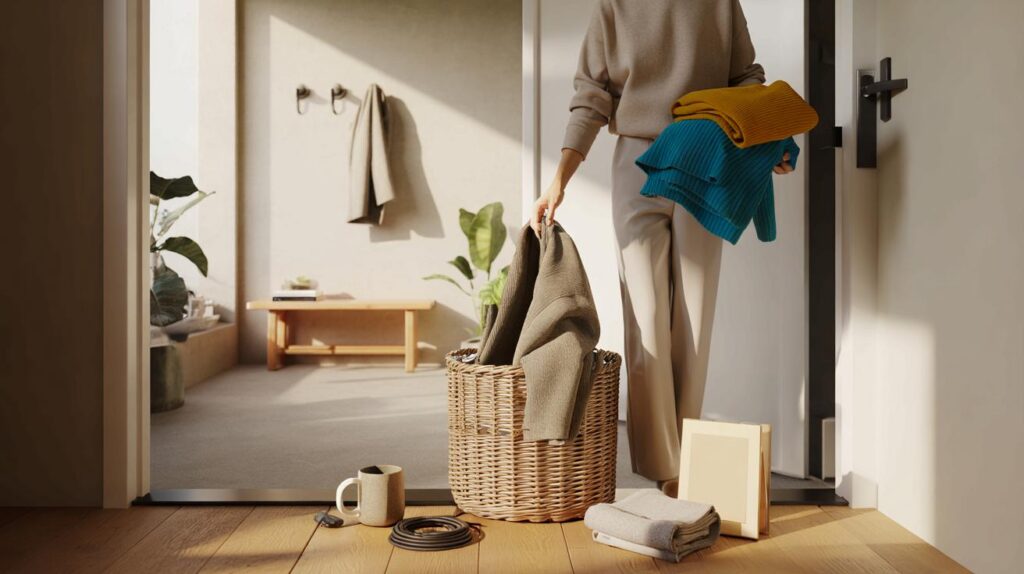
We buy one more basket for the hallway, swear this is the last of the plastic tubs, and promise ourselves that order is just one delivery away. Minutes later, the cupboard door won’t shut and the guilt arrives before the parcel tracking update. The pile is never just a pile. It’s a low hum in the brain that won’t turn off.
The train slid into Paddington as I typed “storage ottoman” for the third time this month. My phone reflected a face that looked tired, not from work, but from keeping track of batteries, cables, and mugs with jokes that stopped being funny years ago.
On the platform a woman balanced three shopping bags and a rucksack. She smiled at one bag like it had solved her life. I knew that smile. I also knew the droop when you carry it home.
A friend texted, “I keep purging, but it all comes back.” I sent her one line. A small rule that behaves like a tiny doorman.
The trick? A gatekeeper with pockets.
The One-In, One-Out Rule
The idea is clean as a whistle: when something enters, something else leaves. Not next week. Now. It sounds strict, but it’s weirdly freeing.
Think of it as the house saying, “I’m full, pick who stays.” You’re not punishing yourself. You’re simply keeping rooms at the size they already are.
One reader told me she tried it with mugs. She brought home a cheery new one, opened the cupboard, and chose an old office freebie to go to the charity shop.
Two weeks later, she did the same with jumpers. Then towels. She didn’t touch the sentimental shelf yet. That can wait.
What changes isn’t the number, it’s the direction. Stuff stops flowing only one way. Your capacity becomes visible, like lines on a swimming pool.
There’s less dithering because each purchase carries a question: “Who are you replacing?” That single pause is where clutter dies.
Habits That Actually Stick
Build an exit basket by the door. Not a tidy bowl. A real bag, box, or tote labelled for the charity shop, school donation, or recycling centre.
Every time something new lands, drop its counterpart in that basket. Then give it a weekly appointment, like bins night or Saturday brunch run.
Pair this with a shelf quota. One shelf for T‑shirts, not three. When it overflows, decide in two minutes what moves out. That limit is a kindness, not a punishment.
Let’s be honest: no one really does a grand declutter every day. Small, honest boundaries do more than heroic sprints that leave you knackered.
Most people trip on perfection, not mess. They wait for a long weekend or a new set of organisers, then burn out.
Skip the fancy containers for now. Use a paper bag, a spare shoebox, a sticky note that says “Out.” The habit matters; the basket doesn’t.
We’ve all had that moment where a keepsake isn’t just an object but a voice from another room. The fix isn’t to harden up. It’s to slow down and separate the memory from the item, gently.
Touch it, tell the story, take a photo if that helps. Keep one item per person, per era, if you like. A soft rule beats a hard heart.
One organiser told me, “The goal is not less for the sake of less. It’s fewer decisions to make room for better ones.”
“Space you can breathe in is not empty. It’s a tool.”
- One‑in, one‑out: tie every purchase to a release.
- Exit basket: keep it by the door, not in a cupboard.
- “Maybe” box: date it, review in 60 days.
- Five‑minute reset: one surface, one song, then stop.
Let Space Do the Talking
When space returns, the room starts giving you feedback. You find keys without looking. Your shoulders drop before you know why.
What sticks are rules that respect both your life and your laziness. Friction low, payoff quick, almost no willpower required.
Space is not empty; space is possibility.
If you’re worried about regret, create a clearing lane: the “maybe” box with a date. Out of sight, not out of reach. If you don’t fetch it in two months, the decision makes itself.
For families, make it a game: when a toy arrives, a toy gets to “go on holiday” to another kid. Kids love being the hero of someone else’s story.
If you live small, even better. Constraints turn vague intentions into clear calls. The flat tells you what fits. You answer with a nod.
And yes, sometimes you will misjudge. You’ll donate a baking tin, then crave cinnamon rolls. Borrow one, enjoy the rolls, carry on. You’re not building a museum. You’re raising a home.
Minimalism that lasts is rarely austere. It’s a kitchen with one clear counter, a wardrobe where everything gets worn, a hallway that doesn’t snag your bag. It’s a little more daylight on the table, a little less noise in the head.
Start with the front door and work in. Clear the mat, the hook, the drop spot. Then the bedside table. A drawer. A shelf. Each small win changes the weather of the day.
Soon you notice buying slows because you’ve made room for a better question: “What experience do I want here?” That question rearranges rooms more than any storage hack ever could.
| Point clé | Détail | Intérêt pour le lecteur |
|---|---|---|
| Gatekeep inflow | Match every new item with one that leaves | Stops clutter at the source, cuts decision fatigue |
| Build low‑friction routines | Exit basket by the door, weekly drop‑off slot | Makes decluttering automatic, not willpower‑based |
| Protect emotions | Use a dated “maybe” box and story‑first keepsakes | Reduces regret, keeps meaning while reducing volume |
FAQ :
- How strict is one‑in, one‑out supposed to be?Think of it as a default, not a punishment. Apply it to high‑clutter zones first (clothes, books, mugs). Be softer with true keepsakes and seasonal gear.
- What do I do with gifts?Receive with warmth, then decide if it earns a spot. If not, pass it to a friend or charity where it will be used. Gratitude isn’t the same as storage.
- What if family won’t play along?Lead by example on your stuff and shared surfaces you’re responsible for. Set a household “exit day” and keep it light. People join when they see benefits, not lectures.
- How do I start if I’m overwhelmed?Pick one surface you see every day: the coffee table or bedside. Clear it in five minutes, not perfect, just clear. Repeat tomorrow. Momentum beats marathons.
- Won’t I regret letting things go?Use the two‑month “maybe” box before final decisions. Photograph items with memories. If you never go back for them, your present life has voted.



Loved the “gatekeeper with pockets” visual. I’ve tried one‑in, one‑out before, but tying it to an exit basket by the door is the piece I was missing. Defintely stealing the weekly drop‑off appointment idea—feels doable.
Isn’t one‑in, one‑out too rigid for life changes? If I start running, I might need multiple layers, shoes, accessories. Do I purge older stuff immediately, or is there a grace period so the habit doesn’t punish growth?